|
The Benton Institute for Broadband and Society, in conjunction with the American Association for Public Broadband (AAPB), have released a new report designed to guide communities on the process of establishing a community-owned broadband network. "Own Your Internet: How To Build a Public Broadband Network" offers a comprehensive look at the steps needed to move forward with a community project.
Kudos to AAPB and the Benton Institute for tackling the project!
0 Comments
It's official - April will be the last fully funded month of the Affordable Connectivity Program, or ACP. The FCC issued a public notice this weeks announcing the ACP's conclusion and providing additional guidance for providers and reminders of the notices required to be sent to ACP households. Providers, CLICK HERE if you want to wade through the FCC notice. Or, CLICK HERE to read a great summary written by the Benton Institute.
 Our latest edition of CBAN's Member Spotlight is now available for viewing on the CBAN YouTube channel! Our topic is CBAN associate member netElastic Systems, and Tom Mitchell took some time to introduce netElastic to our membership and talk about some of the challenges they are working to help broadband providers overcome. Founded in 2016, netElastic has worked with 40% of the top carriers in the world and many smaller carriers to understand their network infrastructure challenges. Based on broadband provider input, netElastic developed one of the first software-based broadband network gateways (BNGs) from the ground up. netElastic vBNG is now deployed globally and has been nominated for numerous industry innovation awards. CLICK HERE to watch our Member Spotlight and learn more about netElastic Systems!
The FCC has released the results of a survey of ACP recipients, and the data clearly shows the impact that the Affordable Connectivity Program has had. Among key statistics in the survey report:
Clearly the sunset of the ACP will hit rural Americans and low-income Americans hard. While bill in Congress would restore funding for ACP through the end of the year, there has been little action on this legislation. ACP enrollment stopped in February and the last full month of the ACP subsidy is expected to be April. CLICK HERE for a PDF of the FCC's Fact Sheet on the ACP survey.
The March open meeting of the Federal Communications Commission (FCC) on March 14th has a couple of items of interest to broadband providers.
CLICK HERE for more details on the FCC meeting and a link to watch the meeting live online.
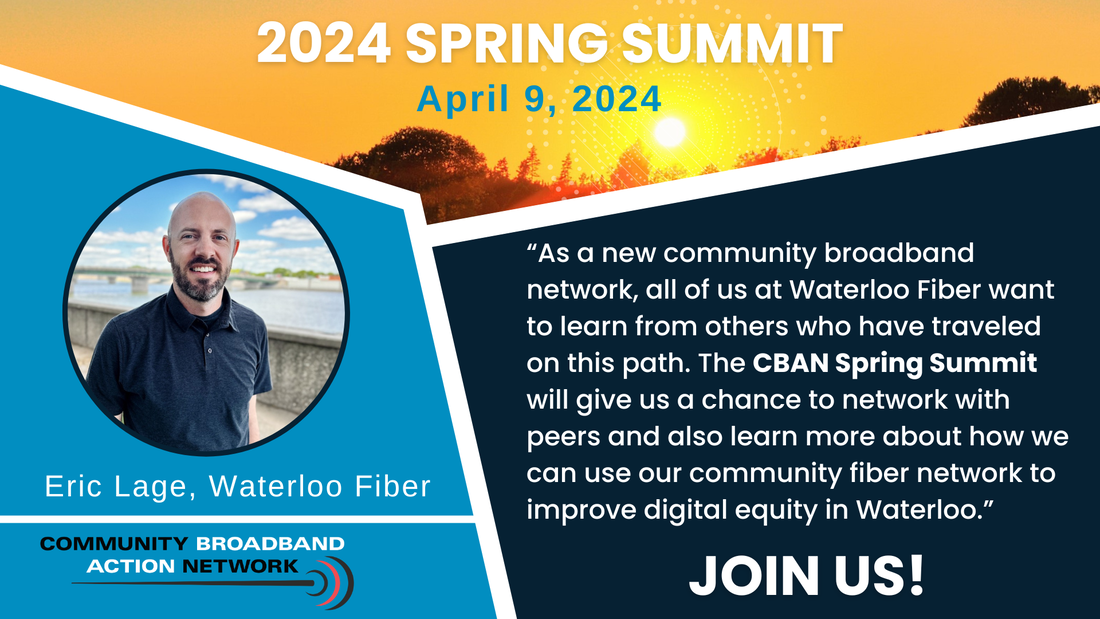
It's been an exciting February for CBAN as we put the finishing touches on our 2024 Spring Summit and see continued membership growth! We've recently had four great, community-focused broadband providers join the CBAN family.  The Community Agency of O'Brien County (TCA) is a joint action agency co-owned by 4 towns in northwest Iowa - Hartley, Sanborn, Paullina, and Primghar. In the early 2000's, these communities joined forces to build broadband in their communities and created TCA to serve as the operating entitity. TCA continues to play a large role in bringing better broadband to the area, including building fiber in rural areas.  Lockridge Networks is a real homegrown success story! Lockridge operates a robust fixed wireless broadband network in portions of southern Iowa and northern Missouri. Lockridge started when parent company Lockridge, Inc. were experiencing challenges with poor internet speed and service. So they connected their four lumberyards with fixed wireless internet, slowly expanding to their employees and eventually residents in the communities they serve. Lockridge has leveraged Iowa Broadband Grants to expand their coverage and begin building fiber networks in some areas.  Long Lines Broadband, based in Sergeant Bluff, Iowa has a long history of community-focused broadband service in northwest Iowa. Long Lines was also a key player in providing assistant to numerous municipal broadband networks as they were established in the 1990's and early 2000;s.  Western Iowa Networks is one of the most progressive and community focused providers in Iowa. From humble roots as Breda Telephone Company providing landline phone in the western Iowa town of 500 beginning in 1905, WIN is now wone of the largest independent telephone and broadband companies in Iowa. They continue to grow and play a vital role in bringing better broadband to underserved areas in western Iowa. We are excited to have each of these great providers as part of the CBAN network!
In an open letter to the FCC, a number of broadband advocate groups have posed an interesting question: would a brief amnesty period for recipients of the Rural Digital Opportunity Fund (RDOF) or Connect America Fund II (CAF II) to walk-away from projects they haven't completed help make those areas eligible for upcoming BEAD funding? Under rules of the Broadband Equity Access and Deployment (BEAD) program, areas that received grants under CAF II or RDOF are not eligible to receive BEAD funding. The problem is that because those other programs offered meager support mechanisms for high-cost areas, many of those projects are likely to not get built. In a letter addressed to FCC Chairwoman Jessica Rosenworcel, a large number of groups are appealing to the FCC to take action so that areas that are likely to be left behind by CAF II or RDOF are opened for BEAD eligibility. "The undersigned ask that the FCC grant that request (including extending it to CAF II awardees) or otherwise provide a mechanism for relinquishment that ensures that thousands of communities across rural America are not disconnected from the benefits of reliable and affordable broadband Internet." - Letter to FCC dated 2/28/24 Among the organizations co-signing the letter to the FCC are:
 ImOn Communications, a CBAN provider member based in Cedar Rapids, Iowa, has announced its intentions to bring fiber services to the central Iowa community of Marshalltown. Hats off to ImOn for its most recent expansion and congratulations to the Marshalltown community! Below is a news release provided by ImOn about the announcement. ImOn Communications Announces Fiber Internet Network Build in Marshalltown ImOn Communications, a leading provider of high-speed Internet services across Iowa, is excited to announce the expansion of its 100-percent-fiber-optic network to Marshalltown, Iowa.
In 2024, ImOn plans to build out the city of Marshalltown, providing its ultra-fast fiber Internetservice to both homes and businesses. “We are thrilled to welcome Marshalltown to the ImOn family,” said ImOn President and CEO, Patrice Carroll. “This expansion marks our commitment to supplying Iowans with the reliable connections they need to thrive in the digital age, backed by the highest level of customer service and dedicated community support.” ImOn has greatly appreciated the cooperation with the City of Marshalltown and looks forward to continuing the collaboration. The ImOn team has been working with the city’s Public Works Department throughout the early stages of the build effort, ensuring the network design is in line with the city’s requirements and laying the groundwork for construction to begin. ImOn will continue to communicate with the appropriate city officials, as well as the broader community, to keep them informed of all construction plans. “The COVID year taught Marshalltown that access to Internet is pivotal for students,” said Marshalltown Mayor Joel T.S. Greer. “As mayor, I am personally excited that ImOn is willing to bring its residential and business fiber network to our community as another option for residents, business owners, and students. I am hearing good things from public leaders in the communities where ImOn has built its network.” Once service is live, Marshalltown homes will have access to Internet speeds up to 1 Gigabit per second, and businesses will have access to Internet speeds up to 10 Gigabits per second. Both residential and business services will be powered by ImOn’s extremely reliable network. Marshalltown is the fifth metro service area to be added to ImOn’s advanced fiber network. Founded in Cedar Rapids in 2007, ImOn’s service area has grown rapidly over the last five years to include the Cedar Rapids metro, Iowa City metro, Dubuque metro, Siouxland area, and now Marshalltown. For more information about ImOn Communications and its services, please visit www.imon.net. About ImOn Communications: Headquartered in Cedar Rapids, Iowa, ImOn Communications is a leading broadband provider delivering ultra-high-speed, reliable internet, TV, and phone services to residential and business customers. ImOn’s growth over the past decade is thanks to its commitment in offering the latest in high-speed broadband technology and delivering the highest level of customer service while making an impact in the communities it serves one connection at a time. For more information regarding ImOn Communications, visit www.ImOn.net. |
Broadband Bytes NewsPresented by the Community Broadband Action Network and curated by Curtis Dean. Archives
March 2024
Categories
All
|

 RSS Feed